Most small businesses do not choose a finance tech stack. They accumulate one. A bank account here, some accounting software a friend recommended, a folder of receipt photos on someone’s phone. It works, roughly, until the numbers stop agreeing with each other and nobody can say why.
The job to be done
A finance stack has one purpose: get money in, record it accurately, and tell you what happened without a week of manual work. Most SMEs handle this badly because the pieces were bought at different times for different reasons. The bookkeeping lives in one place, expenses in another, and the forecast in a spreadsheet only one person understands. Data gets keyed in twice. Errors creep in. Month-end drags on for days.
Options worth knowing about
Think in layers, not brands.
The ledger is the core. This is your accounting software, and everything else plugs into it. Xero starts at around £16 a month for its Ignite plan, though UK prices rise again on 1 September 2026, so check the current figure. QuickBooks Simple Start is £16 a month, with Essentials at £28. FreeAgent is £19 a month for sole traders and £33 for limited companies, and free if you bank with NatWest, RBS or Mettle. All three handle Making Tax Digital. None is dramatically better than the others for a typical small business.
The capture layer feeds the ledger. Dext photographs receipts and invoices and pushes them through automatically, from roughly £24 a month. It saves real time. It is also another subscription, and it still needs a human to check the categories.
The payments layer is easy to forget. Tools like GoCardless collect direct debits automatically, and most accounting software now chases overdue invoices for you. Getting paid faster does more for your cash than any forecast.
The forecasting layer sits on top. Float pulls figures from your accounting software to build a rolling cash flow view, priced in US dollars from $59 a month. Useful when cash is tight. Overkill when it is not.
A recommendation framework
Simple logic beats a universal winner.
- If you are a sole trader or contractor, start with FreeAgent, especially if you already bank somewhere that includes it. Add nothing else until you feel real pain.
- If you are a service business under £500,000 turnover, Xero or QuickBooks plus Dext covers almost everything. Skip the forecasting tool until cash flow keeps you up at night.
- If you carry stock, employ several people, or invoice on payment terms, a forecasting layer starts to earn its cost. Add it then, not before.
The mistake is buying tools ahead of the problem. Every subscription you add is another login, another sync to break, another thing to reconcile.
What the tools will not do for you
No stack tells you whether your business is healthy. It records what happened. It does not judge it.
Your software will show a profit figure. It will not tell you the profit is thin for your sector, or that your debtor days have quietly doubled. It shows the balance. It does not warn you that you are one late payment from trouble. That reading still needs judgement, and most owners were never taught how to do it.
Automation does not fix bad habits either. If receipts vanish before they reach Dext, or invoices go out late, no app rescues you. These tools speed up good process. They do not create it.
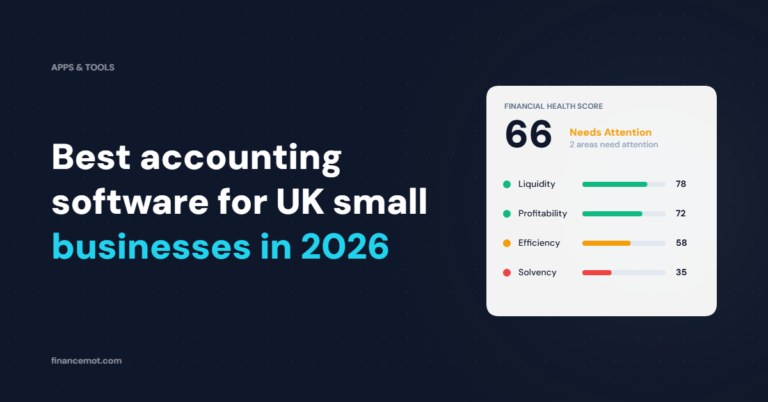
This is the gap FinanceMOT fills. Your stack keeps the records clean; FinanceMOT reads them and tells you what they mean. It scores your financial health from 0 to 100 across liquidity, profitability, efficiency and solvency, flags the KPI signals worth watching, and hands you a plain executive summary with downloadable management reports. It works alongside the tools you already use, not in place of them.