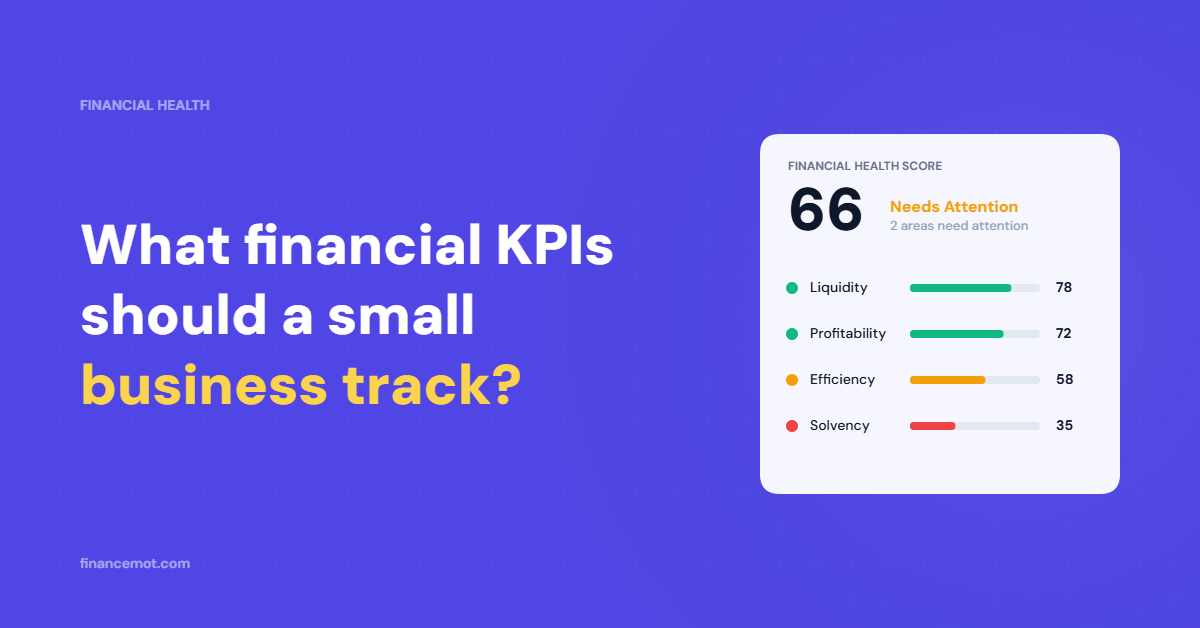
Most small businesses track too many numbers, badly. The financial KPIs that actually matter for an SME come down to eight: cash runway, gross margin, net margin, debtor days, current ratio, revenue growth, customer acquisition cost, and revenue per employee. Track these monthly and you will see almost every problem coming before it hits.
Daniel runs a 12-person logistics firm in Birmingham. Revenue is £1.4m. So when his accountant asked “what are your KPIs?”, Daniel proudly opened a spreadsheet with 47 metrics on it.
However, when the accountant asked “which three are you actually acting on?”, Daniel paused. None of them. As a result, the dashboard was a comfort blanket, not a decision tool. Furthermore, when revenue dipped 8% the following quarter, none of the 47 metrics caught it because Daniel had stopped looking at any of them.
This is the most common pattern with financial KPIs. Owners track too many, act on none, and miss the changes that matter. Therefore the goal is not more KPIs. It is fewer, better ones, looked at often.
What makes a KPI useful for an SME
A useful KPI does three things. First, it answers a specific question about the business. Second, it can be acted on. Third, it changes when something important changes.
So a KPI like “total revenue this year” fails the second test. You cannot act on a year-to-date number, because by the time you see a problem, it has already happened. Furthermore, “website visitors” might fail the third test if your business does not depend on web traffic.
Therefore the eight KPIs below were chosen because they pass all three tests for the vast majority of UK SMEs.
The 8 financial KPIs every UK SME should track
Below are the eight numbers that, taken together, give you a complete picture of your business. Furthermore, none of them require advanced finance knowledge.
1. Cash runway
Cash on hand divided by monthly operating costs. So this tells you how many months you could keep running if revenue stopped tomorrow. Below 3 months is fragile. Above 6 months is comfortable.
This is the single most important KPI in a small business. As a result, every owner should know their runway figure within 30 seconds of being asked.
2. Gross profit margin
Gross profit divided by revenue. Therefore this measures whether the thing you sell is fundamentally profitable, before any of the overheads of running a business.
Furthermore, gross margin should stay roughly stable month-to-month. So if it suddenly drops 3 percentage points, something has changed in your costs or pricing and needs investigating immediately.
3. Net profit margin
Net profit divided by revenue. As a result, this tells you whether the whole business model works, after all costs including a market-rate salary for yourself.
Below 5% net margin in any industry, you have almost no resilience. Therefore this is the KPI that drives investment decisions, hiring, and dividend timing.
4. Debtor days
Outstanding invoices divided by daily revenue. So this shows how long your money sits with customers before reaching you.
Furthermore, every additional 10 debtor days on a £500,000 business ties up roughly £14,000 of working capital. Therefore reducing debtor days is one of the highest-return KPI improvements available to most SMEs.
5. Current ratio
Current assets divided by current liabilities. As a result, this measures whether you can meet your short-term obligations from short-term resources.
A ratio of 1.5 to 2.0 is healthy. Below 1.0, you owe more in the short term than you can cover. So this KPI quietly predicts most cash crises before they hit.
6. Revenue growth rate
Revenue this period versus the same period last year. Therefore this tells you whether the business is expanding, holding, or shrinking.
Furthermore, watch the trend, not the single number. A business growing 6% per year steadily is in better shape than one that swings between 30% growth and 12% decline.
7. Customer acquisition cost (CAC)
Total sales and marketing spend divided by new customers acquired. So this tells you how much you pay to win each new customer.
As a result, when CAC starts climbing while revenue per customer stays flat, the growth is destroying value. Therefore CAC is one of the earliest warning signs of margin trouble in growing businesses.
8. Revenue per employee
Annual revenue divided by full-time-equivalent staff. Furthermore, this measures operational efficiency in a way that revenue alone never can.
So if you grow revenue from £600,000 to £900,000 but headcount goes from 5 to 9, revenue per employee dropped from £120,000 to £100,000. Therefore the business is less efficient even though it looks bigger.
Build your KPI dashboard
Use the calculator below to enter your figures and see all 8 KPIs in one place. Furthermore, the verdict highlights which one needs attention first.
How often to check each KPI
Different KPIs move at different speeds. So checking gross margin daily is wasted effort. Likewise, checking cash runway only annually is dangerous.
Therefore here is a sensible cadence for an SME. Furthermore, set calendar reminders for each one so the discipline becomes automatic.
Common KPI mistakes
Even owners who know which KPIs to track often misuse them. Watch for these patterns.
Mistake 1: Tracking without targets. A KPI without a target is just a number. So before you start tracking, decide what good looks like for your business. Furthermore, write the target down so you do not unconsciously revise it when results disappoint.
Mistake 2: Annual instead of monthly. KPIs reviewed once a year are not KPIs, they are post-mortems. Therefore the patterns that hurt your business have run for 11 months by the time you see them.
Mistake 3: Reporting without acting. The point of a KPI is to trigger action when it moves. As a result, if you have been watching debtor days climb for three months without doing anything, the KPI is not the problem. The discipline is.
Mistake 4: Vanity metrics. Followers, downloads, brand mentions. Furthermore, these can feel like KPIs but they do not pass the “useful” test unless you can connect them directly to revenue or cost.
For a deeper look at how these KPIs interact, see our wider financial health articles. The HMRC business finance support guidance is also a useful reference for broader UK context.
Whenever something goes wrong, the temptation is to add a new metric to catch it next time. However, more KPIs almost always means worse decisions, not better ones. Therefore if a KPI is failing, fix the discipline, not the dashboard.
What to do this week
Pick three of the eight KPIs above. Furthermore, choose the ones that feel most relevant to where your business is right now. Then set up a simple tracking sheet (Google Sheets is fine) with the figure and a target for each.
So next week, fill in the actuals. The week after, do it again. Within a month you will see patterns. As a result, you will be making decisions on real signal instead of intuition.
The financial KPIs that matter for an SME are not the ones with the biggest dashboards. They are the eight numbers that catch problems early, predict cash issues, and tell you whether the business model still works. Track these monthly. Act on the worst one. Repeat. Almost everything else is noise.