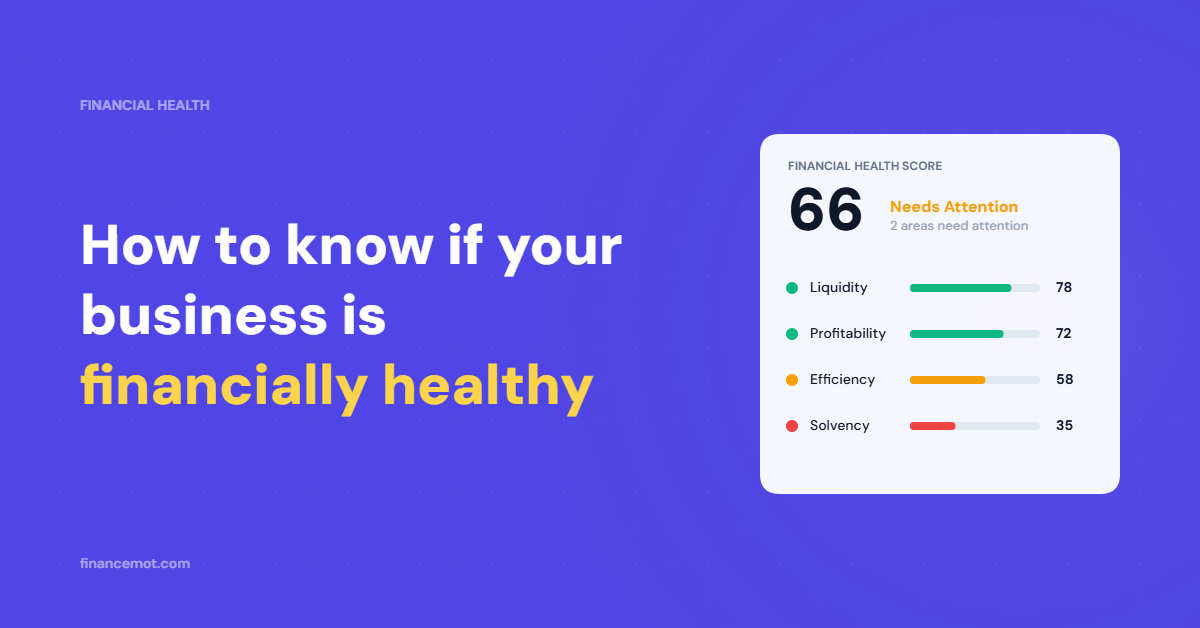
A financially healthy business is not just one that makes a profit. It has cash to absorb shocks, margin to fund growth, and predictable patterns that let the owner sleep at night. This article gives you the five vital signs to check, a simple scoring framework, and a calculator that produces a health score in under two minutes.
Rachel runs a successful interior design studio in Leeds. Last year her revenue was £420,000. Profit was £58,000. So on paper, the business looked strong.
However, when her bookkeeper asked a simple question (how many months could the business survive if revenue stopped tomorrow), Rachel realised she had no idea. As a result, she spent the next week digging through her accounts and discovered the answer was 19 days.
Therefore the studio was profitable but not financially healthy. Furthermore, Rachel had been running the business this way for four years without realising. So when one big client paid late in March, she had to take a personal loan to cover payroll.
This is the gap most owners miss. Profit and health are different things. A financially healthy business is one that can take a hit, recover, and keep going. Most owners only find out which side of the line they sit on when something goes wrong.
What financial health actually means
Financial health is best understood as resilience. So the question is not “is the business making money?” but “can the business keep making money under pressure?” Therefore the five things you check are the five things that fail first when pressure hits.
These are liquidity, profitability, efficiency, solvency, and predictability. Furthermore, weakness in any one of them quietly weakens the others. As a result, a healthy business is one where all five are at least adequate, and at least two or three are strong.
The 5 vital signs of a healthy business
Below are the five categories that matter. Most UK SMEs are strong in two of them and weak in two or three. Therefore the diagnostic question is not “am I healthy?” but “where am I weakest, and what does that put at risk?”
The fast diagnostic: 5 numbers to find this week
You do not need a finance team to run a health check. So pull these five numbers from your accounts and you have everything you need.
1. Cash on hand. What is in your business bank account today, after deducting bills owed but not yet paid. Therefore this is your real cash, not your bank balance.
2. Average monthly operating costs. Add up the last three months of total costs (excluding cost of sales) and divide by three. So this is your monthly burn.
3. Net profit margin. Last 12 months of net profit divided by revenue, expressed as a percentage. Furthermore, calculate this on profit after a market-rate salary for yourself, not below.
4. Debtor days. Outstanding invoices divided by daily revenue. As a result, this tells you how long your money sits with customers before reaching you.
5. Total debt service per month. All loan, lease, and credit repayments per month combined.
Once you have these five, run them through the calculator below for an instant health score.
Why profitable businesses are often unhealthy
Rachel was profitable but had 19 days of cash. So how does that happen? Therefore it is worth knowing the patterns that produce this gap, because they are extremely common in growing businesses.
Profit is timing-blind
Profit is calculated when work is done, not when cash arrives. As a result, a £30,000 invoice raised on 1st March counts as profit in March, even if the customer pays in May. Furthermore, you may have already paid the costs of delivering it, so cash leaves before it returns.
Growth eats cash
Every new customer requires materials, hours, or stock before payment arrives. Therefore the faster you grow, the more cash you tie up in work-in-progress and unpaid invoices. So fast-growing businesses are often the most cash-poor.
Owner pay distortion
Many owners pay themselves below market rate, which makes profit look bigger than it is. As a result, decisions get made on a number that depends on the owner accepting permanent underpayment.
Reading the health score: what good and bad look like
The calculator above produces a score from 0 to 100. So here is how to interpret it.
80 to 100: Strong. The business has cash, margin, and resilience. Furthermore, you have the freedom to invest, hire, or take a proper salary without putting the business at risk.
60 to 79: Functional. The business works but has at least one weak area. As a result, you should identify the lowest score and address it within the next quarter.
40 to 59: Vulnerable. Multiple areas are weak. Therefore one bad month, lost client, or supplier price rise could put the business in real trouble. So this is the band where most failures happen because owners do not realise how exposed they are.
Below 40: At risk. The business needs attention this month, not next quarter. Furthermore, prioritise cash and margin before anything else.
Owners often equate a comfortable balance with a healthy business. However, that balance might be temporary cash from a recent invoice, not sustainable cash from operations. Therefore check what your balance looks like the day after payroll, not the day after invoices clear.
What to do this week
Block out 30 minutes. Pull the five numbers above from your bank account, accounting software, and any active loan statements. Then run them through the calculator. So within half an hour, you will know which of the five vital signs is your weakest, and what that means for the business.
Furthermore, repeat the exercise every quarter. The owners who run calmly are not the ones with the highest scores. They are the ones who track them often enough that nothing surprises them.
For more on individual ratios and what they mean, see our financial health articles. The HMRC business finance support guidance is also worth a read for broader UK context.
A financially healthy business is not just profitable. It is liquid, efficient, solvent, and predictable. So if you only check profit, you are reading one page of a five-chapter book. Run the five-number health check this week. Then act on the weakest score before something forces you to.