You signed up for accounting software, added a receipt app, started a spreadsheet for cash flow, then forgot which one held the real numbers. Sound familiar? Most UK small businesses do not have a shortage of finance apps. They have too many, badly connected, with no clear picture at the end of the month.
The job to be done
What you actually need from finance software is boring and specific. Record what you sell and what you spend. Stay on the right side of HMRC. Know whether you can pay yourself this month. Most owners handle this badly because they buy on features, not on the job. They pick the tool with the longest list, then use a tenth of it.
Making Tax Digital makes this less optional. If you are VAT registered, your records have to be digital and filed through compatible software. So the question is no longer whether to use an app. It is which one earns its place.
Options worth knowing about
Xero. The default for many UK limited companies and their accountants. Strong bank feeds, a large add-on ecosystem, clean reporting. UK plans run from £16 a month for Ignite up to £50 for Comprehensive, excluding VAT, after a price rise in September 2025. The catch: payroll and expenses cost extra per person, so the headline price is rarely the real price.
QuickBooks. The main rival. Sole Trader starts around £10 a month and Simple Start around £16, excluding VAT, though Intuit runs heavy promotions, often 90% off for six months, so check the standard price before you commit. The mobile app and tax estimates are good. Some owners find the interface busier than Xero’s.
FreeAgent. Built for freelancers and small limited companies. Sole trader £19, limited company £33 a month, excluding VAT. The headline feature: it is free for as long as you bank with NatWest, RBS, Ulster Bank or Mettle. If you already bank there, it is hard to beat. It is less suited to product businesses carrying stock.
Dext. Not accounting software. It is the receipt and invoice capture layer that feeds the others. Photograph a receipt and it pulls out the data, then pushes it through to your books. Pricing is set by users and document volume and is not published openly in pounds, so ask for a quote. It is worth it once paper is genuinely drowning you, and overkill before then.
A recommendation framework
If you are a sole trader or freelancer and you bank with the NatWest group, start with FreeAgent free. There is little reason to pay for anything else yet.
If you run a limited company with an accountant, ask what they use day to day. Xero and QuickBooks both do the job well. Matching your accountant saves hours of friction.
If receipts are your weak point, add Dext on top of whichever you choose, not instead of it.
If you are under the VAT threshold and barely trading, a spreadsheet is still fine. Do not buy software just to feel organised.
What these apps will not do for you
These apps record. They do not decide. An app can tell you sales were, say, £18,400 last month. It will not tell you that your margin is slipping, that one client is now 40% of your revenue, or that you cannot afford the hire you are about to make.
They also will not fix bad habits. Unreconciled bank feeds and uncategorised expenses make any tool useless. The software is only as honest as the data you put into it.
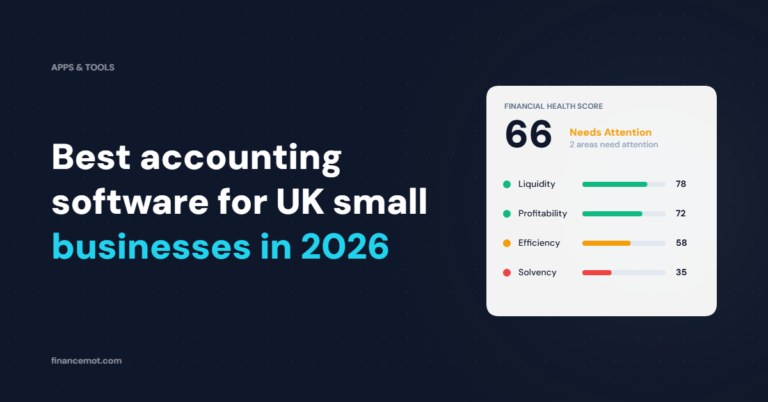
Once your numbers sit in Xero, QuickBooks or FreeAgent, the next question is what they mean. FinanceMOT reads the figures you already keep and turns them into a financial health score across Liquidity, Profitability, Efficiency and Solvency, with KPI signals that flag what is drifting the wrong way. It does not replace your accounting app. It sits alongside it and gives you the executive summary your software leaves out.