Most UK small companies hold something they call a board meeting. Far fewer walk in with a document that tells the directors what actually happened last month. The numbers turn up late, the layout changes every time, and half the meeting goes on working out which figure is correct.
A board pack fixes that. It is the single document directors read before a meeting so they can decide what to do next.
Why this matters at SME scale
Run a company on memory and you make decisions on a version of events that is weeks out of date. By the time a problem reaches the year-end accounts, you have lost months you could have used to fix it.
The law already expects a foundation here. Under the Companies Act 2006, every company must keep adequate accounting records that show and explain its transactions, and officers who fail to do so commit a criminal offence (section 386). A board pack is not itself a legal requirement. It is how you turn those records into decisions instead of leaving them to sit in your accounting software.
The Institute of Directors notes that smaller companies typically hold four to eight board meetings a year. Without a consistent pack, every one of those meetings starts cold.
What it actually involves in practice
For a 10 to 50 person business, a board pack is not an 80-page corporate document. Six to ten pages is plenty. The point is that it keeps the same shape every month, so directors learn where to look.
Good looks like this. It lands within ten working days of month end. It compares actual performance to the budget and to last year. It leads with a plain summary, not a wall of figures. And it tells you not just what happened, but what needs a decision.
A simple board pack checklist
- A one-page executive summary: the three or four things directors actually need to know this month.
- Profit and loss for the month and year to date, shown against budget and the prior year.
- Balance sheet as at the month end, with debtors and creditors clearly visible.
- Cash position today, plus a rolling 13-week cash forecast.
- Five to eight key numbers on one page, each flagged red, amber or green.
- A short written commentary on the main variances and what is being done about them.
- A clear list of the decisions the board is being asked to make.
- The same template every month, issued on a fixed date, no exceptions.
What good looks like
Take a 28-person engineering firm near Manchester. For years the monthly meeting meant the founder reading profit figures off a laptop while everyone else took his word for it.
They switched to a seven-page pack, issued by the eighth working day. In month one, the KPI page showed debtor days creeping from 42 to 61. The cash forecast showed the squeeze that would cause nine weeks out. They chased two slow customers and changed terms on a third before it became a problem. Same data they had always held. The difference was seeing it in time to act.
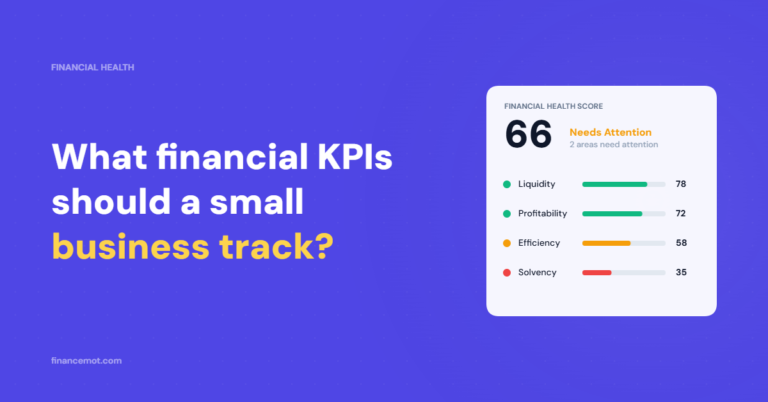
You do not need a finance team to build that KPI page. FinanceMOT reads your figures and produces a financial health score out of 100 across the four pillars of Liquidity, Profitability, Efficiency and Solvency, with red, amber and green signals on the numbers that matter. The downloadable management report and executive summary drop straight into a board pack, and multi-period tracking shows directors the trend rather than just this month. Your accountant shows you the numbers. FinanceMOT tells you what to do about them.