A business with 12 staff and one with 48 often run their finances the same way. One founder signs off everything, checks the bank balance on a Friday, and calls that control. It works until it does not. Financial governance, meaning the rules, checks and reporting that keep the money side of a business honest and visible, has to grow as the business does. The gap between the governance you have and the headcount you now carry is where most avoidable trouble starts.
Why this matters at SME scale
The UK has roughly 219,900 small businesses employing 10 to 49 people and about 37,750 medium ones employing 50 to 249. Most cross from one band to the other without changing a single financial habit. That is the risk. At 10 people, the founder can hold the whole picture in their head. At 50, that is impossible. Gaps in who approves spending, who checks the bank, and who reads the numbers turn into overspend, missed fraud, or a nasty surprise at year end. The law is not lenient about size either. Under section 386 of the Companies Act 2006, every company director must keep accounting records that show the firm’s financial position with reasonable accuracy at any time, and failing to do so is a criminal offence.
What it actually involves in practice
Governance at 10 employees is light. You need clean books, one person other than the owner who can see the bank, a simple monthly look at profit and cash, and a rule that nobody approves their own expenses. That is genuinely enough.
At 50, the same setup is dangerous. Now you need real separation of duties, meaning the person who raises a payment is not the person who approves it. You need monthly management accounts, a profit and loss, balance sheet and cash summary produced within two weeks of month end. You need a budget the team is measured against. And you need someone whose actual job is finance, whether an employee or an outsourced controller. The point is not bureaucracy. It is that no single person can move money, hide a mistake, or misread the trend unchecked.
A simple checklist or framework
Work down this list. Tick what you already have, then fix the first gap you hit.
- One person other than the owner reviews the bank statement every month.
- Nobody approves their own expenses, invoices, or pay.
- Payments above a set figure, say £5,000, need a second signatory.
- Management accounts land within 15 working days of month end.
- You compare actual results against a budget, not just last month.
- Bank and control accounts are reconciled monthly by someone who did not process the payments.
- Above roughly 30 staff, one named person owns the finance function.
- Owners or the board see the same numbers, in the same format, every month.
What good looks like
Take a 40-person engineering firm in Leeds. The founder used to approve every invoice from her phone. Now a part-time financial controller runs a fixed month-end close, management accounts reach the two directors by the 12th, and any payment over £5,000 needs a second sign-off. When a supplier double-billed £18,400, the monthly reconciliation caught it before it was paid. None of that is fancy. It is boring, repeatable, and it means the numbers can be trusted.
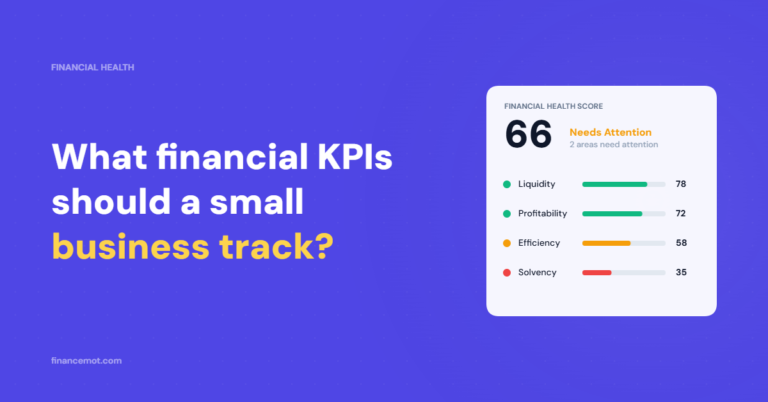
Turning raw figures into a clear decision is the hard part, especially when you sit between a bookkeeper and a full finance team. FinanceMOT reads your accounts and returns a financial health score across Liquidity, Profitability, Efficiency and Solvency, with KPI signals that flag which control or trend needs attention this month. The downloadable management report and executive summary give owners and boards the same numbers in the same format, and multi-period tracking shows whether a problem is a one-off or a pattern. Your accountant shows you the numbers. FinanceMOT tells you what to do about them.